The Wheel of the Year
The Wheel of the Year is a seasonal cycle of eight celebrations that mark the changing seasons and important turning points within the natural year. It moves through periods of growth, abundance, harvest, decline, rest and renewal before beginning again.
Here at The Wheel at Home, the Wheel follows the Southern Hemisphere seasons, so the dates are roughly six months opposite to those commonly shown on Northern Hemisphere calendars. Beginning with Samhain as we move towards winter, the Wheel continues through the seasons until Mabon and the autumn equinox bring us back towards Samhain once again.
For me, following the Wheel is less about following a particular religion or belief system and more about giving the year some rhythm and structure. It encourages us to notice what is happening in nature, acknowledge the changing seasons and make room for seasonal traditions, food, creativity, reflection and celebration.
The Traditional Festivals and the Modern Wheel
Although the Wheel of the Year is often spoken about as an ancient Pagan calendar, the familiar eight-Sabbat Wheel celebrated today is a modern Pagan framework. It brings together festivals and seasonal observances from different historical traditions rather than representing one ancient calendar that was celebrated in this exact form.
Four of the celebrations — Samhain, Imbolc, Beltane and Lughnasadh — have their roots in traditional Gaelic seasonal festivals. These marked significant points within the pastoral and agricultural year and were associated with the changing seasons, livestock, farming, harvest and the rhythms of everyday life.
Within modern Wiccan traditions, these four festivals became known as the Greater or Major Sabbats.
The remaining four points of the Wheel are connected to the astronomical year: the Winter Solstice, Spring Equinox, Summer Solstice and Autumn Equinox. People across many different cultures have observed solstices, equinoxes and seasonal changes for thousands of years, but these four points were not originally part of one ancient Celtic eight-festival calendar.
Their inclusion alongside the four Gaelic festivals to create an evenly spaced cycle of eight Sabbats developed through modern Paganism and Wicca during the twentieth century. Within this system, the solstices and equinoxes became known as the Lesser or Minor Sabbats.
The names commonly used for these celebrations today — Yule, Ostara, Litha and Mabon — also come from a mixture of historical and modern sources. They should not be understood as four ancient Celtic festivals that historically belonged alongside Samhain, Imbolc, Beltane and Lughnasadh.
Together, the four Greater and four Lesser Sabbats form the eight-spoked Wheel of the Year that is now widely recognised within modern Paganism, Wicca and many forms of contemporary witchcraft.
The terms Greater and Lesser, or Major and Minor, are traditional classifications within this modern system and do not mean that one group of Sabbats is more important or meaningful than the other.
It is also worth noting that the terminology is not used consistently across modern Pagan and witchcraft resources. You will come across websites and books that label the Sabbats the other way around, referring to the solstices and equinoxes as the Major Sabbats and the four cross-quarter festivals as the Minor Sabbats.
Throughout The Wheel at Home, I use the traditional Wiccan classification of Samhain, Imbolc, Beltane and Lughnasadh as the Greater or Major Sabbats, with Yule, Ostara, Litha and Mabon as the Lesser or Minor Sabbats. This is simply the convention I use throughout the site so that everything remains consistent.
The Eight Sabbats of the Modern Wheel
Samhain
30 April – 1 May | Major Sabbat
Samhain marks the end of the harvest season and the beginning of the darker half of the year. With roots in the traditional Gaelic festival of Samhain, it is associated with endings, remembrance, ancestors and honouring those who came before us.
Yule — Winter Solstice
Around 21 June | Minor Sabbat
Yule falls at the Winter Solstice, the longest night and shortest day of the year. From this point, daylight gradually begins to increase again, making this a time associated with rest, renewal, hope and the returning light.
Imbolc
1–2 August | Major Sabbat
Imbolc is a traditional Gaelic festival marking the beginning of spring and the first signs of new growth. It is associated with renewal, purification, the hearth and home, and preparing for the more active months ahead.
Ostara — Spring Equinox
Around 22–23 September | Minor Sabbat
At the Spring Equinox, day and night are approximately equal and the lighter half of the year is well underway. Ostara is now commonly associated with balance, fertility, new life, growth and fresh beginnings.
Beltane
31 October – 1 November | Major Sabbat
Beltane has its roots in the traditional Gaelic festival marking the beginning of summer. Traditionally associated with fire, fertility and protection, it has become a joyful celebration of growth, life, love, creativity and the abundance of the natural world.
Litha — Summer Solstice
Around 21–22 December | Minor Sabbat
Litha marks the Summer Solstice, the longest day and shortest night of the year. The sun has reached its highest point in the seasonal cycle, making this a celebration of light, warmth, vitality, growth and abundance.
Lughnasadh — Lammas
1–2 February | Major Sabbat
Lughnasadh is a traditional Gaelic festival associated with the beginning of the harvest season. It is a time of gathering, gratitude and abundance, while also recognising the gradual shift towards the darker half of the year.
Mabon — Autumn Equinox
Around 20–21 March | Minor Sabbat
Mabon falls at the Autumn Equinox, when day and night once again reach a point of approximate balance. In the modern Wheel of the Year, it is associated with harvest, gratitude, balance, reflection and preparing for the darker months ahead.
Following the Wheel at Home
Following the Wheel doesn’t have to mean celebrating every Sabbat in an elaborate way or following one particular Pagan or witchcraft tradition. It can be adapted to suit your own beliefs, interests, home and way of living.
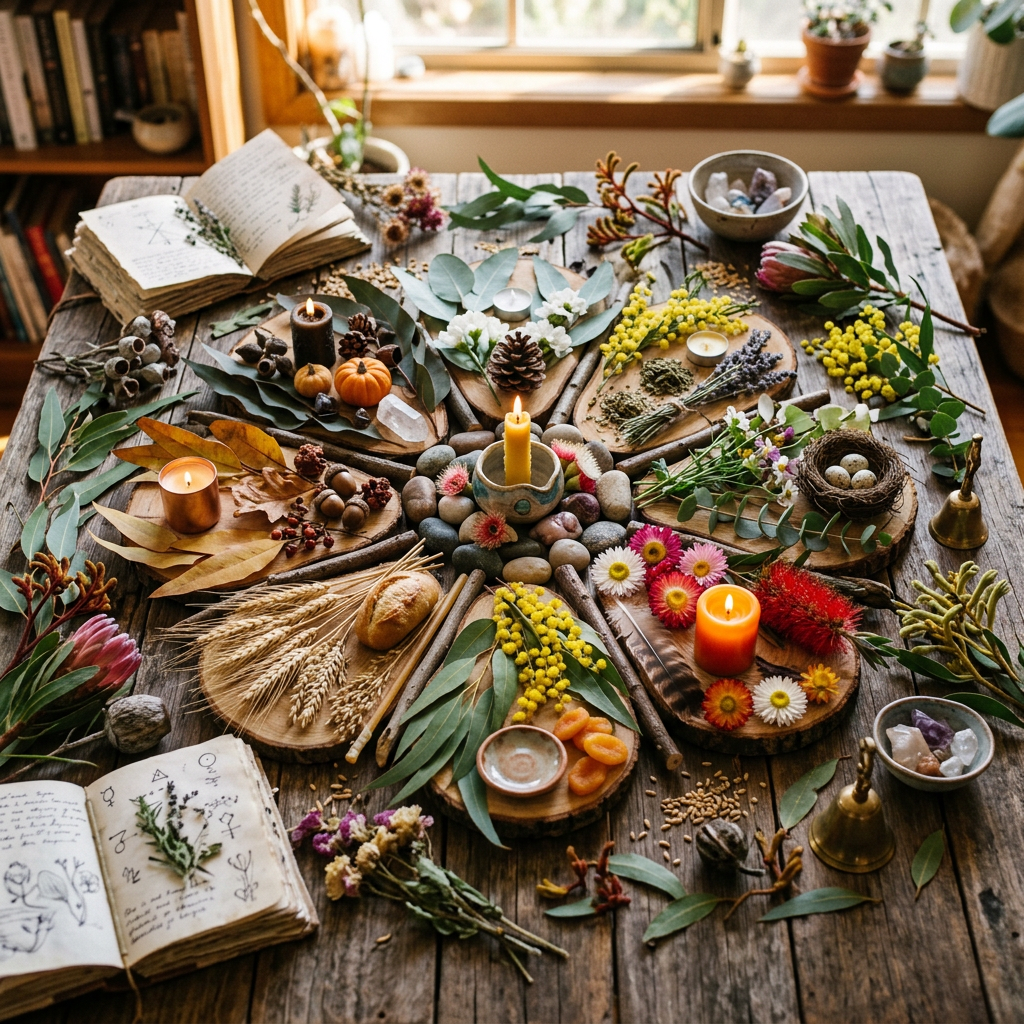
Sometimes acknowledging a Sabbat can be as simple as preparing a seasonal meal, bringing flowers or greenery into the house, lighting a candle, making something with your hands, spending time outside or simply stopping long enough to notice that the world around you has changed again.
Throughout The Wheel at Home, each Sabbat has its own collection of information, traditions, correspondences, seasonal foods, recipes, rituals, crafts and ideas for bringing that part of the Wheel into everyday life. Some are drawn from older traditions, while others are modern practices or simply enjoyable ways of connecting with the season.
There is no need to do everything, and there is no single correct way to follow the Wheel. The seasons continue to turn regardless, giving us another opportunity each year to notice where we are, reconnect with the natural world and enjoy what that particular part of the year has to offer.
 The Wheel at Home